Why Christian Education Still Matters
Catching up with Kitchell
By Matt Kitchell, Head of School, First Presbyterian Day School
I was a Christianity major in college, and my professors were, by and large, kind, compassionate, and sincere. Yet the theological lens that shaped my early years was heavily influenced by Neo-Orthodoxy. I was often told, implicitly and explicitly, that my view of Scripture was simplistic and dogmatic because I believed the Bible to be the infallible and inerrant Word of God.
For a 17-year-old who had experienced God but knew very little about the Bible, this proved unsettling. Without a firm apologetic for the resurrection of Jesus or a framework for defending my faith, I found myself grappling with questions I had never expected to ask: Does God even exist? If He does, how can I know for sure?
What I failed to recognize at the time was that the college environment itself was shaping how I viewed the world in often subtle, unexamined ways. I arrived without a solid foundation, and the prevailing secular assumptions of higher education nearly swallowed me whole. And that is worth pausing over: I was a Christianity major, seeking to know Christ, and found myself disoriented by what I was learning in my religion classes!
That reality has only intensified for students today. Our graduates are sent into institutions filled with competing and increasingly hostile worldviews. They walk into classrooms and organizations that claim neutrality and inclusivity, promising that “all are welcome.” In truth, these spaces are anything but neutral, and the formation they offer is often deceptive.
The mission and values of First Presbyterian Day School are not peripheral to our work; they are central to our value as a school. We carry a high calling. Everything we do as teachers, coaches, and mentors is mission oriented. As I reflect on my time at FPD, I am deeply grateful to serve alongside colleagues who understand and embrace that calling.
Our broader culture, and even many Christians, have grown skeptical of the importance of Christian education. There is a growing belief that church, family, and schooling operate independently, that the worldview formed in secular institutions has little bearing on one’s faith or moral life. That assumption is simply untrue.
We live in a moment when identity is self-constructed, truth is treated as relative, and young people are being discipled, often without realizing it, much as I was years ago. Yet today the formative pressures extend far beyond traditional institutions. Social media, entertainment, and ever-refining algorithms now play a powerful role in shaping what students believe is true, good, and worthy of their attention. As the late Voddie Baucham warns, we should not send our children to Caesar and be surprised when they return as Romans.
His statement is provocative, but the insight is pastoral. Formation is always happening. The real question is not whether our children will be discipled, but by whom, and toward what end.
Christian education is one answer. Not the only answer, but a vital one. It seeks to help students develop habits of thinking that align with their faith, both in and beyond the classroom, and to help students see the world through what John Calvin called “the spectacles of Scripture.”
My prayer for our students is that the lens being shaped in them now will prove difficult to shake. That the truth of Scripture, woven faithfully through the curriculum and modeled by Christian mentors, will bear fruit thirty, sixty, and a hundredfold. And that we will be bold in telling others that Christian education, the FPD education is not merely beneficial, but invaluable.
“Train up a child in the way he should go; even when he is old he will not depart from it.” —Proverbs 22:6
This reflection was prompted in part by an article from Dr. Michael Lindsay on the hidden curriculum of higher education.
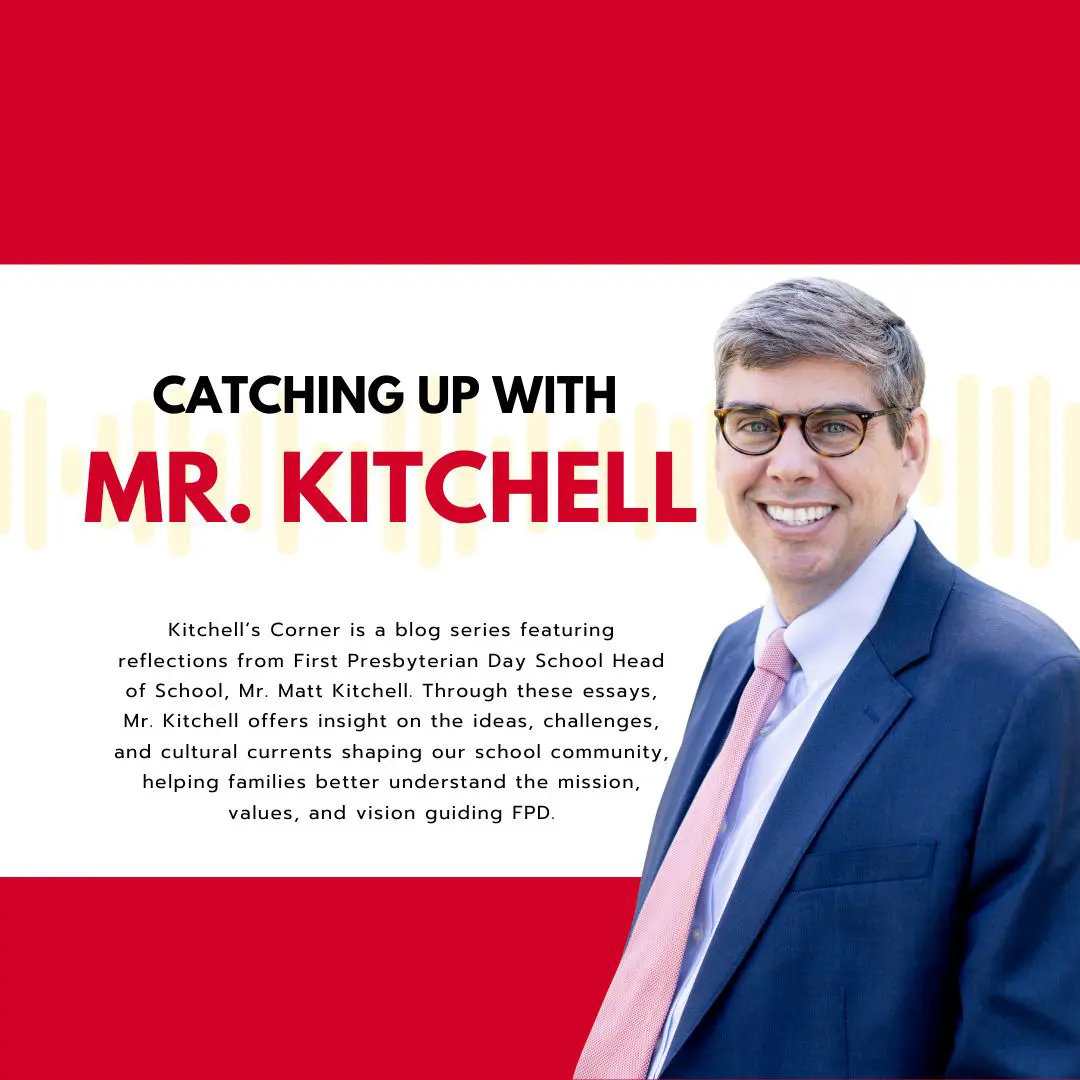
Catching Up with Kitchell is a recurring column from Matt Kitchell, Head of School at First Presbyterian Day School. In each installment, Mr. Kitchell shares reflections on Christian education, leadership, and student formation—connecting timely cultural conversations with the enduring truth of Scripture and the mission of FPD.